
published local estimates, reviewed November 2026. Last reviewed: . Every dollar amount on this page is an estimate; calculated example budgets are illustrations, not completed-job invoices.
Sewer line repair cost by method
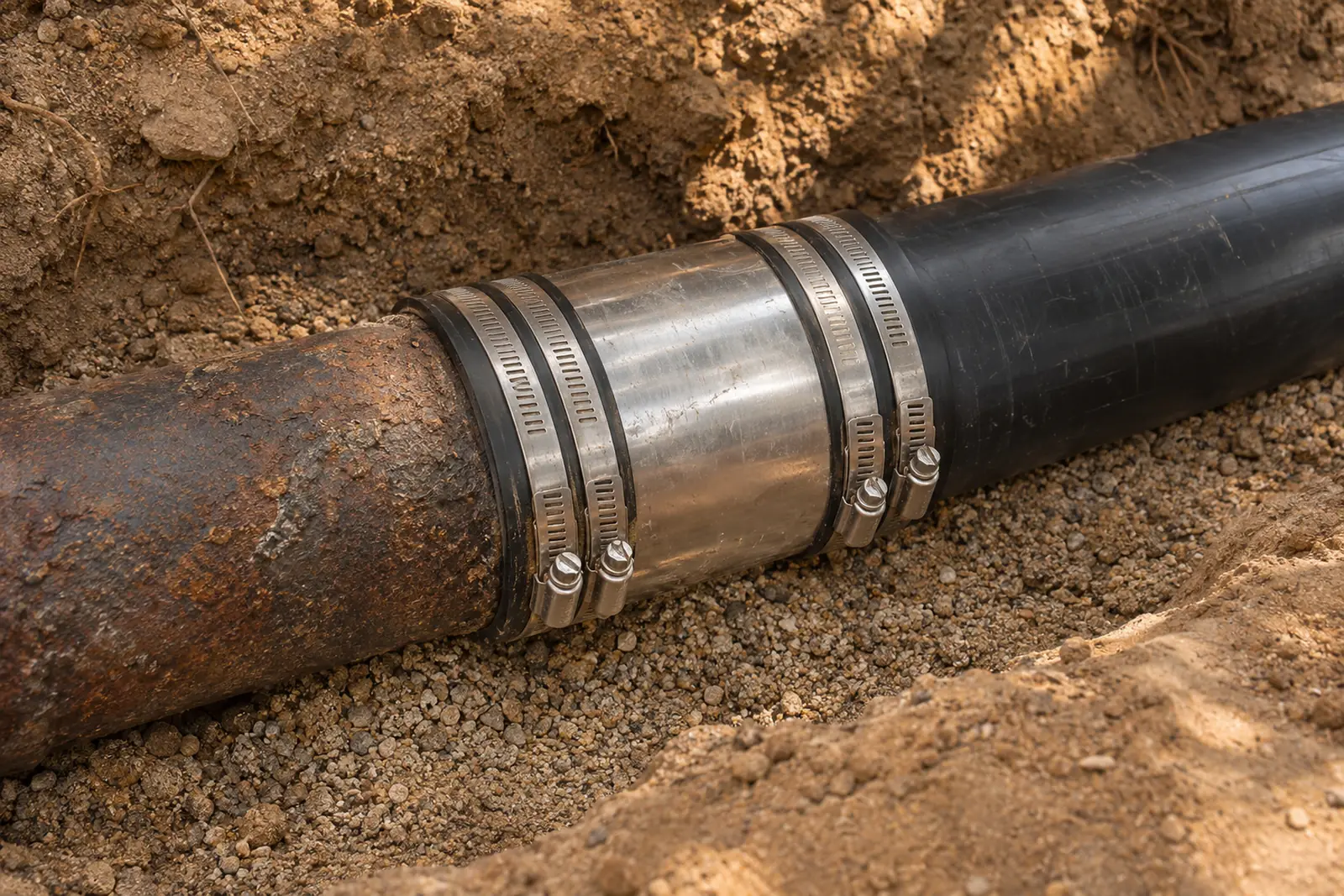
A sewer lateral is the pipe carrying wastewater from a property toward the public sewer. Repairing one damaged section, lining an existing pipe and replacing an entire lateral are different purchases. Compare the same length and finish before comparing prices.
| Method or service | Estimated per foot | Published estimated job total | Scope limitation |
|---|---|---|---|
| Spot repair | Not published / not applicable | Estimate: $1,200–$5,800 per job | Localized repair; no verified per-foot band |
| Pipe lining (CIPP) | Estimate: $80–$250 per foot | Estimate: $1,500–$5,000 per job | Job and footage ranges describe different scopes |
| Pipe bursting | Estimate: $135–$155 per foot | No verified typical total; price by scope | Total depends on measured length and access pits |
| Trenchless repair (category) | Estimate: $100–$310 per foot | Estimate: $4,000–$10,000 per job | Lining or bursting—not an additional service charge |
| Full replacement | Estimate: $60–$250 per foot | No verified typical total; price by scope | See length-specific budgets below; no single typical total |
| Camera inspection | Not published / not applicable | Estimate: $150–$500 per job | Diagnostic work, not structural repair |
| Hydro jetting | Not published / not applicable | Estimate: $400–$800 per job | Cleaning, not replacement of damaged pipe |
Get a price range for your repair
Two quick steps. No payment and no obligation to hire.
Get a price range for your repair
Step 1 of 2
Do not add competing ways of pricing the same repair
A job range and a per-foot range are alternative descriptions, not two charges to stack together. Ask whether inspection, cleaning, access pits, permits and restoration are bundled. A short lining job can have substantial setup costs; a long or complicated project can exceed a published job band.
Trenchless sewer repair cost: what the estimate buys
Trenchless sewer repair includes methods that avoid opening a continuous trench along the entire pipe. The published category estimates are $4,000–$10,000 per job or $100–$310 per foot—not both added together. “Trenchless” does not mean excavation-free, restoration-free or suitable for every failed line.
Lining versus bursting
Pipe lining creates a cured liner inside an existing pipe. The estimate should identify the lined length, cleaning and preparation, connection treatment, curing and final camera check. A lining bid must explain whether the existing pipe is suitable; a liner is not a substitute for correcting an unsuitable route or unresolved slope problem.
Pipe bursting replaces a pipe along its existing route by breaking the old pipe while pulling in new pipe. Its estimated footage price does not tell you whether launch and receiving pits, connections or surface repairs are included. Ask for each access location before assuming the yard will remain untouched.
Compare the finished-property cost, not only the pipe price. Avoiding a long trench can reduce the amount of surface work, but pit restoration and site-specific requirements still matter. If open excavation is recommended instead, ask the contractor to show the inspection finding that makes it the better choice. EPA rehabilitation reference ↗
Request a property-specific estimateCost drivers: why similar homes receive different bids
These factors change scope rather than applying a reliable universal surcharge. No verified local dollar allowance is available here for depth, difficult access, material upgrades, public street work or landscaping. Ask for itemized site allowances instead of adding guessed percentages.
| Driver | Effect on cost | Ask the contractor to document |
|---|---|---|
| Depth | Deeper excavation can require more digging, protective measures and backfill. | Located depth, excavation scope and any protection included. |
| Length | More pipe means more material and work; setup costs do not disappear on a short job. | Measured footage, starting and ending points, and minimum charges. |
| Access | A usable cleanout differs from working through a slab, narrow side yard or difficult pit location. | Access openings, equipment entry and who closes the openings. |
| Material | Existing pipe condition, replacement specification, diameter and connections affect the method. | Pipe or liner specification, connection count and preparation required. |
| Permits & inspections | Fees depend on the actual approvals and inspections, not just pipe length. | Applicable permits, official fee basis and inspection arrangements. |
| Street or sidewalk work | Public-right-of-way work can add approvals, traffic provisions and surface reconstruction. | Separate public-work scope and the authority responsible for approval. |
| Landscaping restoration | A backfilled trench is not necessarily a restored lawn, driveway or planting bed. | Finish materials, restored area and who handles landscape work. |
Permit and inspection fees have a published local estimate of $250–$625. This is not an official City fee schedule and may not include every approval. The City’s simple plumbing permit guidance includes sewer piping repairs; work in the public right-of-way needs a separate scope check. Verify the actual approvals and fees before signing. City plumbing permit guidance ↗ · City public-right-of-way requirements ↗
Confirm where the private lateral ends and what work belongs to the property owner. Do not assume a repair becomes the City’s expense simply because the damaged section lies outside the yard. City sewer lateral responsibility guide ↗
Three worked example jobs with itemized estimated totals
These replacement budgets use the same published rate at different measured lengths. They are not three claimed real-world projects. The assumptions are deliberately visible: the pipe-work estimate excludes a separately charged camera inspection and permit/inspection allowance. If those items are already included in a contractor’s rate, do not add them again.
Example 1: estimated 30-foot replacement
A shorter measured run. The lower footage does not prove the job is simple; access and restoration still need a written scope.
| Line item | Estimated amount |
|---|---|
| Pipe work: 30 feet × $60–$250 per foot | Estimate: $1,800–$7,500 |
| Separate camera inspection | Estimate: $150–$500 per job |
| Permit and inspection allowance | Estimate: $250–$625 |
| Calculated total for priced items only | Estimate: $2,200–$8,625 |
| Restoration, street work, unusual access and other exclusions | Not priced; additional contractor estimate required |
Example 2: estimated 50-foot replacement
A medium-length measured run. This illustrates the cost effect of length without inventing a neighborhood, pipe material or contractor invoice.
| Line item | Estimated amount |
|---|---|
| Pipe work: 50 feet × $60–$250 per foot | Estimate: $3,000–$12,500 |
| Separate camera inspection | Estimate: $150–$500 per job |
| Permit and inspection allowance | Estimate: $250–$625 |
| Calculated total for priced items only | Estimate: $3,400–$13,625 |
| Restoration, street work, unusual access and other exclusions | Not priced; additional contractor estimate required |
Example 3: estimated 75-foot replacement
A longer measured run. Check how many connections and surface areas are included rather than treating the upper estimate as a price ceiling.
| Line item | Estimated amount |
|---|---|
| Pipe work: 75 feet × $60–$250 per foot | Estimate: $4,500–$18,750 |
| Separate camera inspection | Estimate: $150–$500 per job |
| Permit and inspection allowance | Estimate: $250–$625 |
| Calculated total for priced items only | Estimate: $4,900–$19,875 |
| Restoration, street work, unusual access and other exclusions | Not priced; additional contractor estimate required |
These totals are incomplete planning budgets, not all-in offers. They combine the low endpoints and high endpoints of separate bands; they are not statistical predictions. Have the contractor replace every allowance with a written amount and identify any other charges before using a budget to make a borrowing decision.
What homeowners insurance typically does—and does not—cover
A broken sewer line is not automatically an insured loss. California’s insurance guidance identifies wear and tear as generally outside homeowners coverage. Age-related deterioration, ordinary maintenance and a recurring blockage should not be budgeted as covered repairs without a policy-specific answer. California homeowners insurance guidance ↗
Separate the failed pipe from damage caused inside the home. A policy may treat these as different losses. Sudden damage from a covered event may qualify under the policy, while sewer backup may require separate coverage. If you have service-line coverage, ask specifically whether your underground sewer lateral, excavation and restoration are included, and what exclusions or limits apply. Neither an endorsement nor a contractor’s opinion guarantees a paid claim.
Ask the insurer what evidence it needs before non-emergency work: footage, photographs, the cause of failure, location and itemized scope. Keep mitigation receipts and follow its instructions while addressing immediate health hazards. Compare your deductible and coverage limits with the approved scope; do not subtract a hoped-for insurance payment from the repair budget. California residential insurance guide ↗
Financing: compare the total repayment, not just the monthly payment
Possible funding routes include savings, a bank or credit-union loan, home-equity borrowing or a contractor-arranged credit offer. Availability depends on the lender and borrower. SD Sewer Repair does not offer financing or promise approval, a rate or an interest-free promotion.
Request the annual percentage rate, fees, term, total repayment, security requirements and any prepayment penalty. For a deferred-interest offer, ask what happens if the promotional balance is not fully repaid on time. Borrowing against the home creates different risks from an unsecured loan. Compare written offers for the same financed amount and keep unpriced restoration out of any supposedly final budget.
Financing is separate from authorizing repair. Read both agreements and keep the contractor’s payment schedule tied to defined work. California’s contractor guidance calls for written scope, permit responsibility, a detailed payment schedule and signed change orders. CSLB contract guidance ↗
How to compare sewer repair quotes fairly
- Start with the same diagnosis. Obtain the camera footage, located defect and measured repair length. Ask why cleaning, spot repair, lining or replacement is recommended.
- Normalize the scope. Match pipe length, material specification, access locations, connections and finish. Two different repairs are not comparable because they share a label.
- Separate included and excluded items. Mark inspection, cleaning, permits, excavation, haul-away, backfill, surface restoration and final testing as included, excluded or not applicable.
- Check the contractor. Verify the current license and ask about insurance, who performs the work and the proposed warranty’s limits. Check a California contractor license ↗
- Document changes. Ask who approves additional work and how it will be priced. Get verbal promises into the signed agreement.
A free estimate does not necessarily include a free camera inspection. Ask about visit and diagnostic charges before scheduling. We do not guarantee another contractor’s terms, availability or pricing. Keep the written proposal and inspection report together when seeking another opinion.
Red flags in a low bid
- A price without inspection evidence or a defined length.
- A trenchless promise that never identifies access pits or pipe suitability.
- “Restoration included” with no description of the finished surface.
- Permits marked as unnecessary without a scope-specific explanation.
- Unexplained allowances that become payable only after excavation starts.
- Pressure to sign before reviewing the scope, license or payment terms.
- A warranty that has no written exclusions or responsible company.
A low bid is not automatically a bad bid. It may describe a smaller repair or a more efficient method. Ask the contractor to reconcile the difference in writing. Conversely, a high total does not prove a better result if the diagnosis and exclusions remain vague.
How to use these estimates
These San Diego estimates were last reviewed on November 26, 2026. Readers outside San Diego can use them to understand how sewer pricing is structured, but labor, approvals and site conditions differ by region. Your final price comes from a camera inspection and a written quote.
Sewer line repair cost questions
What is the average cost to repair a sewer line?
There is no single average, because the method and length drive the total. In San Diego, published local estimates put a spot repair at $1,200–$5,800 per job and replacement at a per-foot rate that grows with the measured run. A camera inspection shows which repair applies before you compare prices.
Will homeowners insurance cover a broken sewer line?
Often not for wear, age or tree roots, which many policies exclude. Some insurers sell a separate service-line endorsement, and sudden damage to the house may be treated differently from the pipe itself. Read your policy wording and ask your insurer before work starts.
Is trenchless sewer repair cheaper than digging?
Not always. Trenchless work can cost more per foot but may save on excavation and surface restoration under a driveway, patio or mature landscaping. Compare the full scope, including access pits and restoration, rather than the per-foot rate alone.
Why do sewer repair quotes vary so much?
Quotes may describe different repairs. One may cover a short spot repair while another replaces the full lateral, includes permits or restores concrete. Ask each contractor to list the length, method, permit, access and restoration items so you compare the same job.
Do permit fees add to the cost of sewer repair?
Usually, yes. Published local estimates put San Diego permit and inspection costs at $250–$625, though the actual fee depends on the approvals your work needs. Ask whether the quote includes permits and who schedules the inspection.
Should I pay for a camera inspection before a repair quote?
A recorded camera inspection is the best basis for a repair price, because it shows the defect, its location and the pipe material. Ask for the footage and a written finding so you can share them with other contractors for comparison quotes.