
Sewer Line Repair in San Diego
Compare options. Talk to a licensed local pro.
Tell us what's going on
Step 1 of 2
Find the damage. Compare repair options. Call (805) 232-3911 or request a San Diego sewer contractor connection. Your sewer line carries wastewater away; the lateral connects it to the public main.
Symptoms that mean your sewer line needs attention
One slow sink may have a local blockage; several affected fixtures or recurring stoppages warrant investigating the shared line. Symptoms do not automatically mean replacement.
Multiple fixtures backing up
A toilet, shower and sink affected together point toward a shared drainage problem. Note which fixtures are involved and whether using one causes water to appear in another.
Recurring slow drains or odors
A blockage that returns after clearing deserves a closer look. Persistent sewage odors, gurgling or slow drainage are reasons to investigate, not proof that the entire line needs replacement.
Roots or repeated blockages
Roots visible on camera can explain a stoppage. Clearing them restores a passage, but ask whether an opening or damaged joint remains and how the proposed repair addresses it.
Damage found during an inspection
An escrow inspection may identify cracks, separated joints or a collapsed section. Request the recording, the defect location and a written explanation before accepting a repair recommendation.
If sewage is overflowing, stop water use and get professional assistance. The City advises turning off water to control flow and preventing sewage from reaching storm drains. Do not treat an online request as emergency dispatch. City overflow guidance ↗
Tell us what you’re seeing.
Describe the affected fixtures, recurring symptoms and property ZIP code.
Sewer repair methods compared
These methods solve different problems. “Trenchless” is an approach, not a diagnosis. Compare scope and disruption below; suitability depends on your property.
| Method | When it fits | Typical disruption | Relative cost considerations |
|---|---|---|---|
| Spot repair | One localized defect, with the remaining line in usable condition. | Excavation around the damaged section; access and depth determine the footprint. | Limited scope can mean a lower total; difficult access or pavement can change that. |
| Pipe lining (CIPP) | A suitable existing pipe that can be cleaned and used to host a cured-in-place liner. | Access points and preparation rather than a continuous trench; wastewater use is interrupted. | Compare preparation, liner length and connection work against excavation and restoration. |
| Pipe bursting | Replacement along an existing route where the pipe, surrounding utilities and site permit bursting. | Launch and receiving excavations; connections and utility clearance need assessment. | Replacement equipment and access pits add cost; reduced surface restoration may offset it. |
| Full replacement | Widespread damage or a layout or slope problem requiring a new or corrected pipe route. | Open excavation along the work area, followed by backfill and surface restoration. | A broader scope; depth, length and restoration can be substantial cost drivers. |
The EPA describes lining and bursting as alternatives to excavation. Its collection-system guidance does not establish residential suitability or local prices; a contractor must assess your lateral. Cost comparisons describe trade-offs, not San Diego price rankings. EPA rehabilitation guidance ↗
What to ask about a camera inspection
The City’s sewer spill prevention guidance describes a licensed plumber televising the pipe after clearing the lateral. Ask for the footage and a written explanation of the findings. City inspection guidance ↗
- Where is the problem relative to the building and property line?
- Was the full proposed work area inspected?
- Which specific finding supports the recommendation?
Questions for a trenchless or excavation proposal
If a quote mentions lining, bursting or digging, have the contractor explain in plain language why that method fits the inspection findings.
- What access work is needed on my property, and is closing it included?
- Which alternatives were considered, and why were they ruled out?
- What evidence will show the finished work meets the agreed scope?
Not sure which method fits your line?
Two quick steps. No payment and no obligation to hire.
Tell us what's going on
Step 1 of 2
How to choose the right sewer repair method
Choose a sewer repair method from the camera findings, not the advertising. Consider spot repair for an isolated defect in an otherwise usable line, lining for a suitable host pipe, and bursting for replacement on a suitable existing route. Consider open replacement when damage, access or a slope problem makes those options unsuitable.
Ask what the evidence shows
Request the recording and a marked location, depth and repair length. Ask whether the problem is an obstruction, a structural defect or a drainage alignment issue. If standing water remains, ask whether the proposed method changes the slope or leaves the same low point.
Compare a complete scope
Have the contractor explain why the alternatives were rejected. Include preparation, access, connections, permits and restoration in each proposal. A repair that avoids digging but leaves the documented problem unresolved is not a useful saving. Get the reasoning in writing before authorizing work.
Have an inspection or estimate already?
Include the findings in your request so the problem is clear from the start.
How the sewer repair process works
Discuss these stages with a licensed contractor. A request is not a booked appointment.
- 01
Call or describe the problem
Share the address or ZIP code, affected fixtures, when symptoms started and any previous repairs. Ask about diagnostic charges and availability before agreeing to a visit.
- 02
Inspect and locate
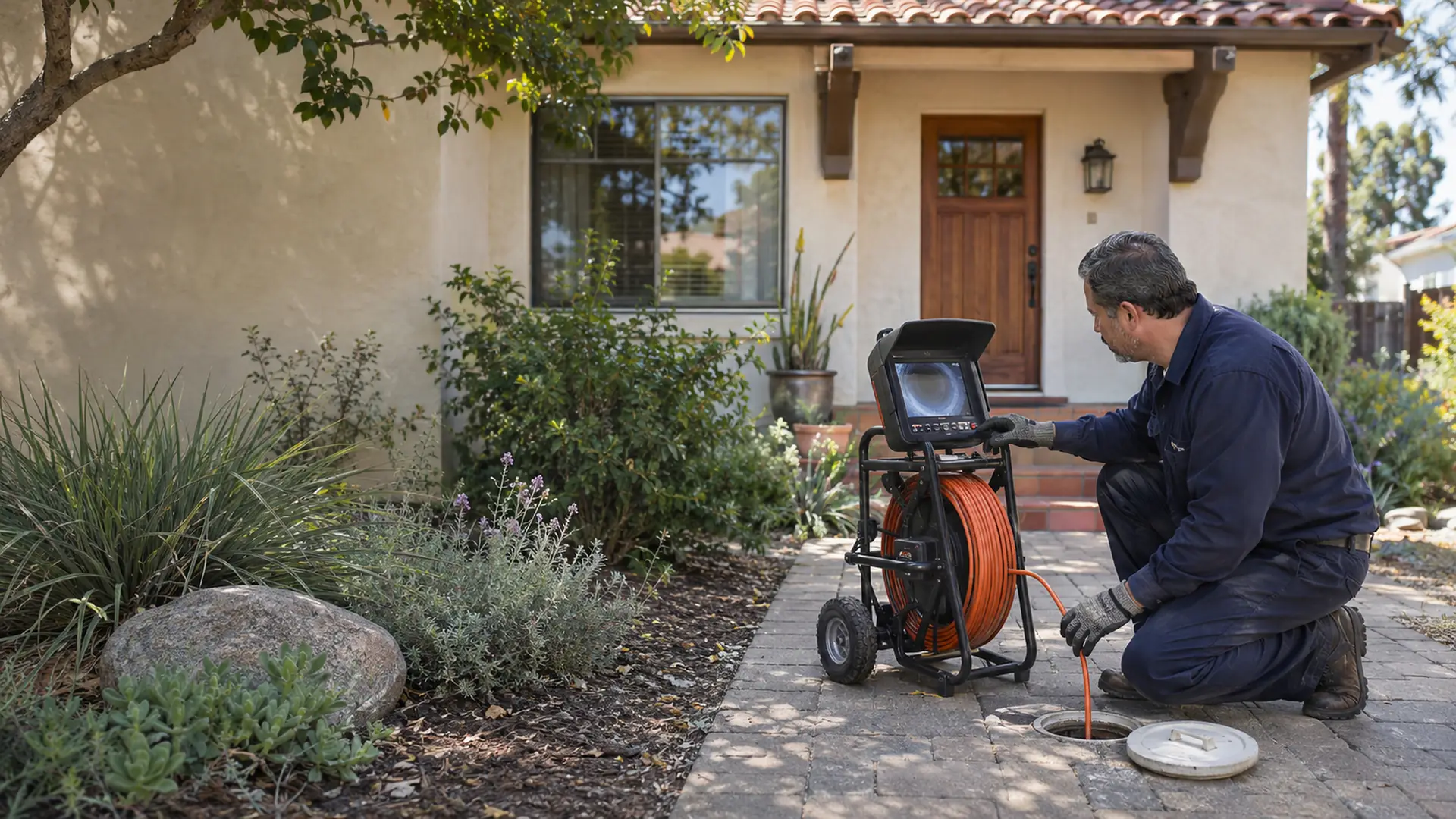
Discuss camera access through a cleanout—a capped opening into the drainage pipe. Cleaning may be needed for a clear view. Request footage and the location of each defect.
- 03
Review the repair proposal
Compare suitable methods for the same repair length. Check the contractor’s actual California license record and obtain a written scope, exclusions and restoration plan before approval.
- 04
Confirm permits
Have the contractor identify the applicable City plumbing permit and any right-of-way requirements. Agree who applies, pays fees and arranges required inspections before repair work starts.
- 05
Repair the line
Confirm access areas and when wastewater use must stop. If findings change the agreed job, ask for an explained change order rather than an unexplained addition to the bill.
- 06
Verify and restore
Ask for completion evidence, any final camera footage, inspection sign-off and restoration covered by the contract. Keep those records with the invoice and any written warranty terms.
Check the official requirements and license record: City plumbing permits ↗ · Right-of-way permits ↗ · California license check ↗
Sewer line repair cost: what determines the range?
Spot repair: $1,200–$5,800 per job. These are published local estimates, reviewed November 2026, not our quotes. Final pricing requires a camera inspection. Replacement and trenchless methods have separate ranges in the cost guide; access and scope still determine the actual proposal.
Compare length, depth, access, connections and restoration. Ask whether camera inspection is billed separately and which conditions require a change order. Trenchless equipment and preparation also affect the total.
Use the sewer line repair cost guide to compare itemized proposals. Request a total that names inclusions and exclusions; do not authorize work on a verbal ballpark alone.
Start with the problem, not a guessed price.
Request a contractor connection; no payment or repair authorization is collected here.
Lateral responsibility, permits and older pipes
Maintenance and repair are different
Owners maintain the lateral to the public main and handle repairs on private property. A plumber-verified right-of-way failure can qualify for City review, not an automatic free repair. The City’s detailed policy considers loss of sewer facilities, access and maintenance; neglected maintenance can lead to billing, and easements follow separate rules. Private plumbing expenses are not reimbursed. City lateral policy and conditions ↗
Confirm the permit for the actual work
Sewer piping repairs appear in the City’s Simple “No-Plan” plumbing permit process. Bulletin 166 requires a Right-of-Way Permit for work in the public right-of-way or water/sewer easement. The property’s jurisdiction and proposed scope matter; a San Diego mailing address alone is not enough. Plumbing permits ↗ · Bulletin 166 ↗
Inspect older pipe materials; do not guess
The City identifies concrete, clay and cast iron as older lateral materials that may have root intrusion or deterioration. An older home in Point Loma, North Park or another neighborhood should prompt a material check, not a neighborhood-wide diagnosis. Renovations may have changed part or all of the line. City lateral guide ↗
San Diego areas served by this resource
Serving homeowners across San Diego and San Diego County. Provide the property ZIP code so its location and permitting jurisdiction can be checked.
Sewer services in Point Loma: access, trees, hillsides and coastal review
Share your ZIP code so availability can be checked for your property. For an active overflow, contact a licensed professional directly rather than waiting for an inquiry.
Where is the property?
Send your ZIP code and symptoms. A request is not a confirmed appointment.
Sewer line repair FAQs
What is the average cost to repair a sewer line?
There is no single average for every repair. Published local spot-repair estimates are $1,200–$5,800 per job; other methods have different scopes. Final pricing requires a camera inspection. Ask for access, permits and restoration in writing. Our sewer line repair cost guide labels these planning estimates and helps compare proposals; they are not our quotes.
Will homeowners insurance cover a broken sewer line?
Coverage depends on your policy and the cause of the break. California’s Department of Insurance says wear and tear is not usually covered by homeowners insurance. Ask your insurer about the pipe repair, resulting damage, exclusions and any applicable endorsements. Save the inspection footage and estimate; do not assume coverage before a claim review. California insurance guidance ↗
Can a sewer line be repaired?
Yes, depending on its condition. One damaged section may be repaired locally; a suitable existing pipe may be lined. Widespread deterioration, collapse or a slope problem can call for replacement instead. The useful question is not simply whether repair is possible, but whether the proposed method corrects the documented defect and leaves a usable line.
Do I need a permit to fix my sewer line?
The City of San Diego lists sewer piping repairs under its Simple “No-Plan” plumbing permit process. Work in the public right-of-way or a water/sewer easement requires a Right-of-Way Permit under Bulletin 166. Have the contractor confirm the requirements for your specific scope and jurisdiction, and identify who obtains permits and arranges inspections. City plumbing permits ↗ · Bulletin 166 ↗
Does trenchless repair mean no digging?
No. Trenchless describes methods that reduce continuous excavation, not a guarantee of zero digging. Lining needs suitable access and preparation; bursting typically needs launch and receiving excavations. Ask the contractor to mark every access point and describe connection work, wastewater restrictions and restoration. Compare those details with an open-trench proposal for the same damaged section.
Who is responsible for the sewer lateral?
City of San Diego owners maintain the lateral to the public main and repair private-property defects. A licensed plumber must establish right-of-way failures for City review. Assistance depends on blockage, access and maintenance conditions; it is not automatically free. Easements have separate rules, and the City does not reimburse private plumbing expenses. City lateral policy ↗
Will cleaning out roots fix a broken pipe?
Root removal can clear an obstruction, but it does not itself rebuild a broken pipe or seal a damaged joint. Ask for inspection findings after cleaning so the underlying condition is visible. If repair is recommended, the proposal should explain where roots entered, which defect is being corrected and what maintenance may still be needed.
How long will sewer line repair take?
Timing depends on the diagnosis, method, access, permit review, inspections and restoration. Ask for a property-specific schedule rather than relying on a same-day promise. Confirm when toilets and other fixtures must stay unused, whether work spans multiple visits and what happens if additional damage is found. An online inquiry is not a scheduled appointment.