
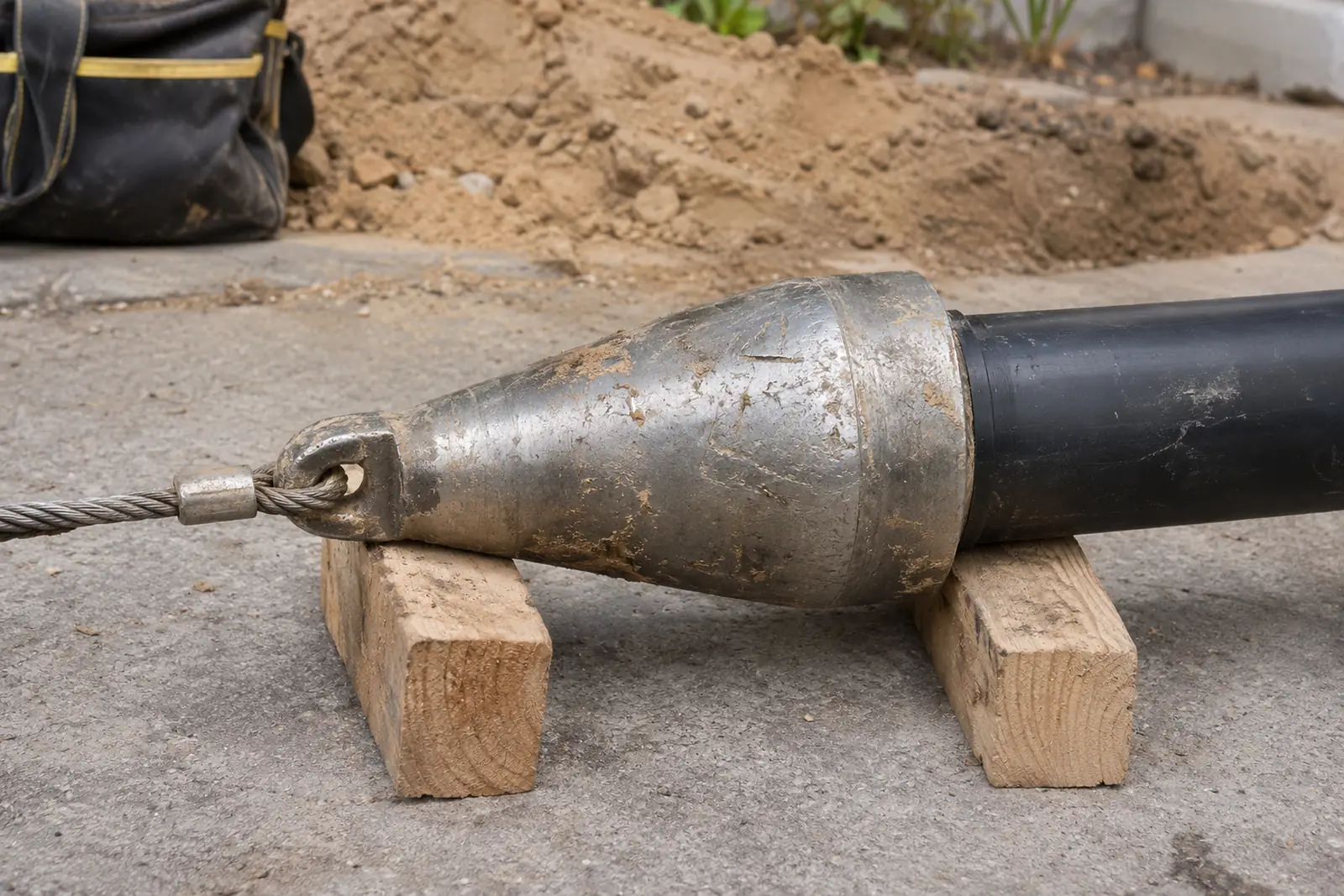
When a new pipe on the existing route may help
Bursting may be considered when replacement is justified but a continuous trench would disturb substantial surfaces. The aim is a new pipe, not an interior coating or a cleaning pass. Ask the contractor to name the damaged length and explain why replacing it along the existing route is feasible.
A finished yard or walkway can make reduced excavation attractive, but access pits and connection work still need space. The method also affects the surroundings of the original pipe, so nearby utilities and site geometry matter. A proposal should show how those constraints are assessed rather than implying that an unseen underground route is automatically safe to reuse.
Bursting suitability depends on more than pipe damage
A suitable candidate needs a replacement scope, an acceptable route and workable launch and receiving areas. Find out how the contractor evaluates host material, bends, nearby services and the planned connections. Equipment capability alone is not the answer: the proposed new pipe must solve the documented problem without leaving a route or access issue unresolved.
If the existing pipe can remain a suitable host, lining may rehabilitate the defects without breaking the old pipe. Compare its preparation and connection requirements with bursting rather than treating both trenchless methods as the same installation. Compare a pipe lining proposal.
Where grade correction, unsuitable alignment or surrounding constraints rule out bursting, excavation may provide the access needed for a new design. Bursting generally uses an existing route, so ask how any low point or layout problem is addressed before selecting it. Assess open sewer line replacement.
Pipe Bursting: step by step
- 01
Establish why replacement is needed
Review the camera findings and proposed new-pipe endpoints. Ask the contractor to distinguish damage from an obstruction and to explain why a repair retaining the host would not be the preferred scope for this section.
- 02
Assess the route and utilities
The contractor evaluates the route, host material, connections and surrounding conditions relevant to bursting. Clarify how utility information is checked and what finding would change the method. Do not let a camera recording stand in for an assessment of everything outside the pipe.
- 03
Plan pits, permits and connections
Identify launch and receiving areas, equipment movement and the restoration required afterward. Agree the new material and connection scope, and confirm the relevant permit and inspection pathway before opening access or initiating the pull.
- 04
Install the replacement pipe
The crew performs the selected bursting operation and connects the new segment as designed. Follow its restrictions on wastewater use and stay clear of equipment and excavations. Changes discovered during access work should be explained before additional work is approved.
- 05
Check and finish the installation
Request the planned completion checks and required inspection records. Confirm the access areas are restored to the contracted standard. Keep the replacement route, endpoints, material and retained sections in your property records rather than relying on the term “trenchless.”
How long a bursting replacement takes
The pulling operation is one stage within a larger job. Access excavation, route assessment, approvals, connections and restoration can take place before or after the new pipe is drawn through. Ask for the complete sequence and the expected period of sewer interruption rather than a duration describing only the equipment operation.
What affects pipe bursting cost
Length, diameter, host conditions, pit depth and equipment access influence the proposed work. Connections, utility assessment and surface restoration can add significant scope around the replacement operation. Confirm whether the quote includes both access areas and the finish of surfaces affected by equipment, not just the length of new pipe.
Compare bursting with an open replacement for identical endpoints and connection requirements. Reduced trench restoration may be useful, but it is not a universal saving. Have the contractor explain how the estimate changes if an access excavation reveals a constraint and whether any alternative work requires fresh authorization.
Pipe Bursting price range
Pipe Bursting figures are published planning estimates, not a SD Sewer Repair quote. Final pricing requires a camera inspection.
For pipe bursting planning, the separately listed permit and inspection estimate is $250–$625. This is not a City fee schedule; confirm actual charges and whether they are already included.
See the cost guide for new-pipe and restoration charge examples
Get pipe bursting options for your property
Two quick steps. No payment and no obligation to hire.
Get pipe bursting options in San Diego
Step 1 of 2
Prepare for the bursting site review
Gather inspection footage and prior utility or sewer records, then show the contractor access constraints along the proposed route. Identify gates, irrigation, landscaping and surfaces that may need protection. Ask which areas must be cleared for pits and machinery without attempting to locate buried services or expose the pipe yourself.
Before the installation, agree restrictions on wastewater use and maintain safe separation from excavations. Move vehicles or outdoor items only as instructed for the actual work footprint. Photograph areas scheduled for disturbance and keep the restoration agreement available so the final result can be compared with the written scope.
San Diego bursting approval questions
Trenchless replacement is not a blanket exemption from City requirements. Sewer piping repair appears in the Simple “No-Plan” permit guidance, and Bulletin 166 addresses lateral installation and public right-of-way or water/sewer-easement work. Ask the contractor to verify which approvals cover the new segment, pits and connections. The EPA describes bursting technology but does not authorize its use on a particular San Diego property.
Pipe Bursting FAQs
Does bursting leave the old pipe in place?
The technique breaks a suitable old pipe as the new one follows its route. Ask the contractor to explain the selected system and what remains underground. It is replacement, not installation of a liner within an intact host.
Will pipe bursting fix a sewer belly?
Do not assume so. The method follows an existing route, and a grade problem needs a specific correction plan. Ask whether excavation or a revised alignment is necessary to resolve the standing-water condition documented during inspection.
Are launch and receiving pits always part of the quote?
Only the written scope establishes inclusions. Ask where each access area will be, how deep it is expected to be and what restoration is covered. A new-pipe length alone does not explain the full surface impact.
Can bursting increase my sewer pipe size?
Any proposed size change needs a site and design assessment plus applicable approval. Do not assume equipment capability makes a larger pipe appropriate. Ask why the new size is needed and how connections and surrounding constraints are addressed.
Why do nearby utilities matter?
Bursting interacts with the space around the original pipe. The contractor must evaluate relevant surrounding constraints and utility information rather than relying only on internal camera footage. Ask what checks support the recommendation and what would rule the method out.
Related sewer services
Sewer line replacement
Review an excavation-based option where the route needs correction.
Sewer line replacement