
Official sources reviewed November 26, 2026 · City of San Diego scope, not countywide advice.
What the local record supports about era
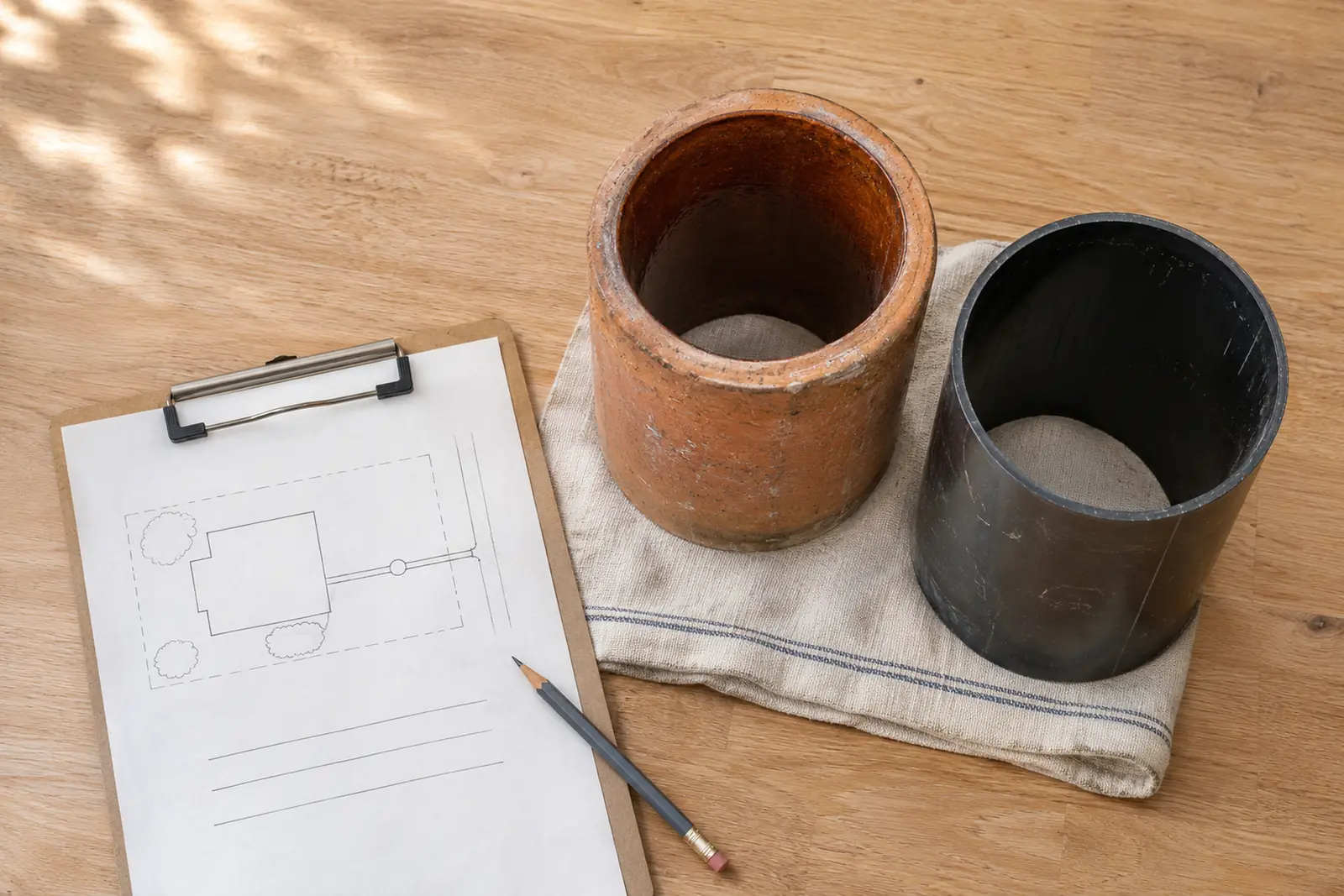
The City's lateral brochure offers a useful older-versus-newer distinction: older concrete, clay and cast-iron laterals may need regular inspection or more frequent cleaning, while newer plastic lines with intact joints and seals may operate for years without problems. That is a conditional maintenance statement, not a dated inventory of residential construction. It does not establish that every house built in a particular decade contains one material.
A home's construction year is therefore a starting question, not a diagnosis. Ask for available plumbing and repair records, then have the material and condition identified during inspection. A replacement proposal should say what existing pipe was observed and which portions were assessed. This guide deliberately avoids a decade chart because no reviewed official source establishes a San Diego household-by-era installation schedule.
Sources: City sewer lateral guide ↗
Older clay: look at the actual joints and defects
Clay appears in the City's list of older lateral materials associated with possible root intrusion or deterioration. Roots or a damaged section are inspection findings to locate, not a reason to condemn every clay connection. Ask whether the immediate problem is an obstruction that can be cleared, a localized defect or damage requiring a longer repair. The City distinguishes clearing an obstruction from repairing a broken lateral.
If replacement by pipe bursting is proposed, require more than the statement that clay is an older material. EPA guidance describes using a bursting head to break the existing pipe and pull replacement pipe through the route. It also identifies constraints involving access, obstructions, adjacent utilities and ground conditions. A material-compatible concept is only one part of a suitable, site-specific replacement plan.
Sources: City sewer lateral guide ↗ · EPA pipe-bursting fact sheet ↗
Older cast iron: do not infer the defect from the name
Cast iron is another older material expressly named in the City's homeowner brochure. The local source groups it with possible root intrusion and deteriorated sections; it does not provide a corrosion timetable or a universal replacement age. Have the inspector identify the visible issue and its extent. A recommendation based only on the words 'cast iron' is not the same as a documented explanation of why the pipe needs repair.
A bursting assessment should include previous repairs and impediments. EPA's implementation guidance calls for obtaining construction and repair history, using closed-circuit television, and removing possible impediments such as certain repair couplings or encasements. This matters because the route being replaced may present obstacles that the broad material label does not describe. Ask which observed conditions support the method and which would require a different approach.
Sources: City sewer lateral guide ↗ · EPA pipe-bursting fact sheet ↗
Older concrete: distinguish material from current condition
Concrete also appears in the City's older-lateral list. The supported homeowner concern is the possibility of roots or deteriorated sections and the resulting need for inspection or cleaning. The reviewed City brochure does not establish a neighborhood prevalence, an exact installation era or a material-specific failure rate. Use the observed condition to define the repair limits rather than treating concrete as proof of an imminent failure.
EPA cautions that some reinforced concrete can be difficult to burst and identifies concrete encasement among potential impediments. That does not prove that a particular home's concrete lateral is reinforced or encased. It means the contractor should identify what is actually present before promising a bursting solution. When the findings do not support the proposed method, ask for a written comparison with excavation and replacement.
Sources: City sewer lateral guide ↗ · EPA pipe-bursting fact sheet ↗
Newer plastic: intact joints and seals still matter
The City says newer plastic laterals with intact joints and seals may function for years without problems. The qualifying words are important: the material name alone does not establish the condition of its joints, installation or route. If a newer line has symptoms, the next useful information is the location and nature of the problem, not an assumption that plastic either cannot fail or must be replaced immediately.
The local homeowner source does not assign separate San Diego installation decades to PVC, ABS or HDPE. Those distinctions should come from the actual records and inspection. EPA's bursting fact sheet also warns that some materials, including HDPE, may not be suitable for a proposed bursting method. Do not turn a general 'plastic' label into a promise about either failure behavior or replacement compatibility.
Sources: City sewer lateral guide ↗ · EPA pipe-bursting fact sheet ↗
The right repair follows the defect, not the era
For an obstruction, the City describes professional clearing as the starting response; a broken lateral needs repair. Cleaning addresses the flow restriction, while structural work addresses damaged pipe. Ask the professional to show what remains after any necessary clearing and to identify which problem the next service would solve. That avoids buying a replacement simply because an old material was seen or assuming cleaning has repaired a break.
For replacement, EPA contrasts open excavation along a deficient pipe with trenchless approaches using the existing route or smaller access openings. Its bursting guidance requires evaluating the pipe, available access and site conditions. Ask a contractor proposing lining to explain the host pipe's suitability and the exact product and approval requirements. No reviewed local source supports a blanket rule that every clay, iron, concrete or plastic lateral should receive the same repair.
If the contractor recommends full excavation, ask which inspected feature makes a less disruptive method unsuitable. If trenchless work is recommended, ask where access openings will be made, how connections are handled and what restoration remains. The objective is a repair that addresses the documented defect within the approved scope, not a contest to use the newest equipment or the oldest material as a sales argument.
Sources: City sewer lateral guide ↗ · EPA pipe-bursting fact sheet ↗ · City sewer construction and development ↗
What a useful inspection report should let you ask
Request the footage, observed material, inspected length, located problem and any limits on what could be seen. Ask whether the recommendation addresses a blockage, a damaged section or the whole connection. These are comparison questions for a homeowner, not an official City report format. If the evidence is incomplete, have that stated before comparing bids that may assume different pipe conditions.
Also confirm whether the proposed work stays on private property or reaches the public right-of-way. Material choice does not remove location-based permit and inspection questions. Use the permits guide to discuss the approval path, and the cost guide to compare included work rather than multiplying an unverified footage rate. A pipe inspection, permit review and written scope answer different parts of the decision.
Sources: EPA pipe-bursting fact sheet ↗ · City simple plumbing permit guidance ↗ · City Bulletin 166: Water, Sewer or Fire Service ↗
Where this guide stops
No official San Diego source reviewed for this guide establishes an Orangeburg installation era, exact neighborhood material shares or a fixed lifespan for these residential materials. Those claims are omitted rather than presented as local fact. Similarly, a municipal construction specification is not proof of which pipe was installed at a particular house. The local expertise here is using the City's actual categories while keeping individual diagnosis separate.
Document the material and defect, then confirm repair suitability, jurisdiction and approval. Ask a licensed professional to explain the findings in writing before authorizing structural work.
Sources: City sewer lateral guide ↗ · City sewer construction and development ↗ · EPA pipe-bursting fact sheet ↗